Have you ever had one of those days when your neck feels unusually tense, your movements feel less natural than usual and you simply do not feel as steady or confident as you would like?
Maybe you spend hours looking at screens. Maybe your shoulders are constantly tight. Perhaps turning your head quickly feels uncomfortable or busy environments seem more overwhelming when your neck is already tense.
According to the official product information, Neck Balance Reset was created around the idea that these experiences may sometimes be connected through the way the neck, eyes, posture and balance system work together.
Rather than presenting another collection of aggressive stretches or complicated exercises, Neck Balance Reset takes a structured approach. It is a 21-day educational self-management program designed to help adults understand patterns, track triggers, practice gentle movement and gradually rebuild confidence in everyday movement.
After reviewing the information behind the program, what stands out most is its focus on structure and pacing.
Instead of simply telling you to stretch more, move more or push through discomfort, Neck Balance Reset emphasizes learning what your body is communicating and choosing an appropriate routine for the day.
That makes it an interesting option for anyone searching for a more organized approach to neck tension, posture strain, head movement and feelings of unsteadiness.
Table of Contents
What Is Neck Balance Reset?
Neck Balance Reset is a 21-day confidence-building program focused on the relationship between neck positioning, posture, visual input and movement.
The program uses a framework called the Cervical Balance Reflex, which describes how information from the neck, eyes, joints, muscles and posture can be interpreted together by the brain when determining where the body is in space.
The central concept is relatively simple.
Your brain is constantly receiving information from multiple systems. Your eyes provide visual information. Your inner ear contributes to balance information. Your joints and muscles provide position signals. Your neck also provides information about the position and movement of your head.
When these signals feel mismatched, noisy or overly reactive, some people may experience movement as less predictable or comfortable.
Neck Balance Reset does not claim that the neck is always the cause of dizziness or balance problems. Instead, it presents the neck as one potential factor worth understanding and tracking.
That distinction is important.
The program is explicitly described as an educational self-management system, not a diagnostic tool or medical treatment.
Neck Balance Reset Review: What Makes the Approach Different?
One of the biggest differences between Neck Balance Reset and the typical online exercise program is that it is not built around the idea that more exercises automatically produce better results.
In fact, the program makes almost the opposite argument.
Many people already have dozens of stretches and exercises saved on their phones. The challenge is knowing which exercises are appropriate, how much to do, when to reduce intensity and how to recognize patterns.
This is where the 21-day structure becomes useful.
Instead of jumping from one tip to another, Neck Balance Reset organizes the process around four stages:
1. Track
The first step is understanding patterns.
The program encourages you to pay attention to things such as:
- Neck stiffness
- Screen time
- Posture
- Stress
- Sleep
- Head movement
- Recovery time
- Visual fatigue
- Daily symptom levels
This can be valuable because symptoms are often easier to understand when you stop looking at individual moments and start looking at patterns.
2. Calm
The second step is reducing unnecessary guarding and preparing the body for movement.
This is where the program introduces breathing, relaxation and its 90-second reset.
The concept is straightforward: rather than immediately forcing mobility when your neck feels reactive, begin with a calming sequence.
That gives you a way to approach movement more deliberately instead of automatically pushing harder.
3. Move
The movement phase emphasizes small, comfortable ranges instead of aggressive stretching.
The program includes gentle neck mobility, awareness of deep neck stabilizers and controlled movement practice.
The emphasis is on pacing and modification.
4. Rebuild
The final stage focuses on coordination.
This includes reconnecting head movement, eye movement, posture and ordinary daily activities.
The goal isn’t to perform impressive exercises.
The goal is to make normal movement feel more manageable and predictable.
What Is the Cervical Balance Reflex?
The Cervical Balance Reflex is the framework at the heart of Neck Balance Reset.
The product presents it as a way of thinking about how the neck, eyes, posture and balance system interact.
Your brain does not rely on a single source of information when determining where your body is in space. It interprets information from different sensory systems.
The Neck Balance Reset approach focuses particularly on the signals coming from the neck.
These position-related signals are often discussed in terms of proprioception, meaning awareness of body position and movement.
The program suggests that when neck signals become guarded, uncomfortable or inconsistent with other sensory information, movement may feel less trustworthy for some people.
This helps explain why the program does not focus exclusively on neck flexibility.
Instead, it combines:
Neck mobility + posture + visual awareness + head movement + pacing + confidence.
That broader approach is one of the more appealing parts of the program.
Neck Proprioception and Balance: Why the Neck Matters
One of the key ideas presented in the program is neck proprioception.
In simple terms, proprioception is the body’s ability to sense position and movement.
The neck plays an important role because it helps position the head in relation to the rest of the body.
Neck Balance Reset uses this concept to create a practical framework for people who feel that neck tension, posture and movement are connected.
Rather than assuming that every symptom comes from the same source, the program encourages users to look for their own patterns.
For example, you may notice that uncomfortable sensations are more likely to appear after a long period of looking down at a screen.
Someone else may notice that stress causes increased neck guarding.
Another person might notice that fast head movements are harder on certain days but easier after adequate rest.
The purpose of tracking is to turn these observations into useful information.
The 90-Second Reset
One of the most practical features highlighted in the product information is the 90-second reset.
The idea is to create a short routine that can be used when the neck or movement system feels reactive.
Instead of immediately adding more stretches, the program encourages a sequence designed around calming down first.
This is particularly appealing because it makes the routine easier to fit into everyday life.
A five- or ten-minute structured routine may be realistic for many people.
By contrast, complicated routines with dozens of movements can quickly become difficult to maintain.
The Neck Balance Reset philosophy is essentially:
Calm first. Then move. Then progress gradually.
That simple sequence can help make the overall program feel less overwhelming.
Why Aggressive Stretching Isn’t Always the Answer
Another point emphasized throughout the product page is the idea that aggressive stretching is not automatically beneficial.
For someone whose neck already feels sensitive or reactive, doing more and pushing harder may not feel like the smartest starting point.
Neck Balance Reset instead promotes small, comfortable movements.
This does not mean avoiding movement.
It means approaching movement with more awareness.
The program encourages participants to recognize when a routine needs to be modified, when intensity should be reduced and when stopping is the better choice.
That safety-first philosophy is one of the strongest selling points of Neck Balance Reset.
The Link Between Screen Time, Neck Tension and Movement
Modern screen habits make the topic especially relevant.
Many people spend large portions of the day working at computers, browsing phones or looking downward.
The Neck Balance Reset program encourages tracking screen-heavy days alongside factors such as:
- Posture
- Neck stiffness
- Visual fatigue
- Stress
- Hydration
- Recovery
This is not presented as proof that screen time causes every balance-related symptom.
Instead, it provides a practical tracking opportunity.
For example, imagine noticing that a particularly long computer day consistently coincides with more neck stiffness the following morning.
That observation does not automatically provide a diagnosis.
But it gives you something useful to investigate and discuss with a qualified professional if necessary.
Neck Balance Reset and the “Guarding Loop”
Another interesting concept in the program is the guarding loop.
When movement begins to feel unreliable, people may naturally become more protective.
They tighten their neck.
They move less.
They become more focused on every sensation.
They anticipate discomfort.
As movement becomes more cautious, ordinary activities can begin to feel unusually significant.
Neck Balance Reset approaches this problem by emphasizing safety, structure and gradual exposure to comfortable movement rather than forcing through symptoms.
The objective is to rebuild familiarity with movement.
That can be a powerful mindset shift.
Instead of thinking, “I need to force my neck to become flexible,” the program encourages a different question:
What movement feels appropriate for me today?
The 7 Clues Explored in Neck Balance Reset
The official presentation highlights seven clues that your neck may be part of a larger movement pattern.
These include the possibility that dizziness or unsteadiness may feel different after aggressive stretching, that neck positioning signals may influence the brain’s position map and that normal scans do not always provide a practical daily self-management plan.
The program also addresses experiences such as:
Crowded or Busy Environments
Busy stores can be visually demanding.
When someone is already feeling tense or unsteady, an environment with lots of movement and visual information may feel even more challenging.
Screen Fatigue
Long periods of screen use can be accompanied by visual fatigue and prolonged neck positioning.
The program encourages participants to track whether these factors appear alongside their own symptoms.
Sensitive Days
Perhaps one of the most practical ideas in the program is the concept of having a sensitive-day routine.
Not every day is the same.
Rather than following a rigid routine regardless of how you feel, Neck Balance Reset teaches you to adjust your approach.
That may mean doing less, slowing down or relying on the calming portion of the routine.
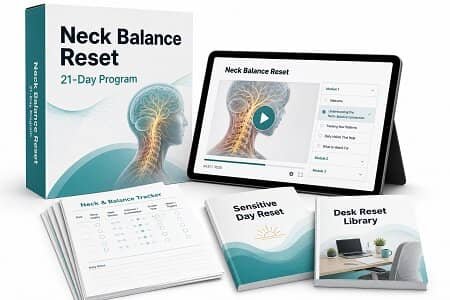
What’s Included With Neck Balance Reset?
The product is positioned as more than a single exercise routine.
According to the official information, the program includes several components designed to work together.
The 21-Day Core Program
This is the main system.
It provides the daily structure for tracking patterns, calming reactivity, practicing gentle movements and gradually rebuilding movement confidence.
Neck & Balance Tracker
The companion journal is designed to help record progress, confidence and individual patterns during the 21-day process.
For people who like having something concrete to record, this can make the experience more organized.
Quick Start Guide
The Quick Start Guide is intended to make getting started easier.
Rather than having to determine what to do first, users are given a starting point for Day One.
Desk Reset Library
The program also includes a Desk Reset Library as a free bonus.
This is particularly relevant for people who spend considerable time sitting at a computer and want simple desk-friendly resets incorporated into their day.
Is Neck Balance Reset Worth It?
For the right person, the main value of Neck Balance Reset appears to be its structure.
There are plenty of generic stretches online.
There are also countless videos promising quick solutions for neck discomfort, dizziness or balance-related symptoms.
The problem is that more information does not necessarily make decision-making easier.
Sometimes it makes things more confusing.
Neck Balance Reset attempts to solve that problem by giving users a sequence:
Track → Calm → Move → Rebuild.
That makes the program easier to understand and potentially easier to follow consistently.
The emphasis on gentle movement and pacing is another positive.
Rather than encouraging users to chase discomfort, it encourages them to recognize when their system needs a lighter approach.
Who May Benefit From Neck Balance Reset?
Based on the official product information, Neck Balance Reset may be particularly appealing to adults who:
- Feel neck tension and unsteadiness may be connected
- Want a structured 21-day routine
- Prefer gentle movement rather than aggressive stretching
- Want to monitor personal triggers and patterns
- Spend substantial time at a desk or using screens
- Want practical tools for normal and sensitive days
- Are interested in rebuilding confidence around everyday movement
It may also appeal to people who are tired of jumping between disconnected online tips and want one organized framework.
Who Should Not Rely on This Program?
The product page is appropriately clear that Neck Balance Reset is not intended to diagnose, cure or treat a medical condition.
Dizziness and balance problems can have many different causes.
Anyone dealing with sudden, severe, unexplained, rapidly worsening or otherwise concerning symptoms should seek appropriate medical evaluation rather than relying solely on a self-guided program.
The same caution applies to people with neurological symptoms, significant fall risk, severe neck pain, recent trauma, heart-related symptoms or other medical concerns.
This is not a program for forcing your body through symptoms.
It is designed around awareness, pacing and modification.
How Long Does Neck Balance Reset Take?
The program is designed to be practical rather than time-consuming.
According to the official information, the minimum routine takes approximately five minutes, while the standard routine generally takes around 10–15 minutes.
That is a reasonable format for a daily self-management program.
Instead of requiring long workout sessions, the structure is designed to fit into ordinary life.
You can think of it as a daily movement-confidence practice rather than a major fitness commitment.
What I Like Most About Neck Balance Reset
The strongest aspect of this program is its philosophy.
It does not simply say, “Here are 20 exercises. Do them every day.”
Instead, it teaches users to pay attention.
The emphasis on a symptom scale, tracking, pacing and sensitive-day modifications creates a more thoughtful approach.
I also like the fact that the program recognizes that confidence matters.
When someone becomes worried about movement, the problem can become bigger psychologically even when the original physical sensation was relatively small.
Having a structured routine can help replace uncertainty with a clear process.
You know what to track.
You know when to reduce intensity.
You know how to approach sensitive days.
And you have a defined 21-day framework rather than an endless collection of random tips.
Neck Balance Reset: Pros and Cons
Pros
Structured 21-day approach: The program provides a defined path instead of scattered advice.
Gentle movement philosophy: The approach emphasizes comfortable ranges and discourages aggressive stretching.
Practical tracking tools: The journal and symptom scale encourage users to identify patterns.
Sensitive-day strategy: The program recognizes that intensity may need to change depending on how someone feels.
Short daily routines: The core routines are designed to fit into a busy schedule.
Focus on movement confidence: The objective goes beyond flexibility and emphasizes feeling more informed and comfortable with everyday movement.
Desk-friendly bonus material: The Desk Reset Library makes the program especially relevant for people dealing with prolonged computer use.
Cons
It is not a medical treatment: Anyone looking for a diagnosis or treatment plan will need qualified healthcare guidance.
Results are individual: Not everyone experiencing dizziness, unsteadiness or neck tension will have the same underlying cause.
Consistency is important: Like most structured self-management programs, the value depends on actually following the routine and tracking patterns.
Gentle does not mean instant: This is positioned as a gradual 21-day confidence-building process rather than an overnight solution.
Final Verdict: Should You Try Neck Balance Reset?
After looking closely at what is included, Neck Balance Reset stands out as a practical, structured option for people who want to explore the potential relationship between neck tension, posture, screen habits, head movement and movement confidence.
What makes it particularly interesting is that it does not rely on the “push harder” philosophy.
Instead, the program focuses on understanding patterns, calming reactivity, using gentle mobility and gradually rebuilding coordination.
That makes the approach feel realistic.
You are not expected to become fearless overnight.
You are not expected to complete complicated workouts every day.
And you are not told to ignore warning signs simply to follow a routine.
The goal is to become more informed about your own patterns and more confident about choosing an appropriate response.
The 21-day structure, 90-second reset, Neck & Balance Tracker, Quick Start Guide and Desk Reset Library work together to create a more complete experience than a basic collection of neck exercises.
For adults who feel that neck tension and unsteadiness may be connected and who want a gentle, organized way to explore that possibility, Neck Balance Reset is certainly worth considering.
The biggest takeaway is simple:
You may not need more exercises. You may need a better sequence.
Neck Balance Reset is built around exactly that idea.
Track what happens.
Calm the system.
Move gently.
Rebuild confidence.
That practical framework is what makes Neck Balance Reset a compelling option for anyone looking to take a more organized, safety-first approach to everyday neck and movement habits.