Weight Loss Relaxed Review: What Is It?
Losing weight can become unnecessarily complicated. Between calorie-counting apps, food scales, rigid meal plans, complicated recipes, intense workout schedules and endless diet rules, it is easy to feel overwhelmed before even getting started.
That is where Weight Loss Relaxed program takes a different approach.
According to the official product information, Weight Loss Relaxed is designed around a simpler philosophy: instead of obsessing over numbers and tracking every bite, users learn practical food swaps, easy plate-building rules, straightforward meal ideas and a structured 1–2 week kickstart plan.
The overall goal is to make weight loss feel less stressful and more manageable.
Rather than presenting another highly restrictive crash diet, Weight Loss Relaxed focuses on everyday foods, simple habits, personal motivation, support and a repeatable method that can fit around normal life.
The program is particularly aimed at men and women who have tried conventional diets before, dislike calorie tracking, feel stuck with their progress or simply want a more relaxed approach to healthier eating.
One of the biggest selling points is convenience. You are not expected to buy specialty foods or become an expert cook. The program emphasizes foods that are available in ordinary supermarkets and meals that can be prepared without complicated instructions.
That makes Weight Loss Relaxed Kickstart worth a closer look for anyone searching for a straightforward weight loss system that prioritizes simplicity.
Table of Contents
Why Weight Loss Relaxed Stands Out
There are countless weight loss programs available online, so the obvious question is: what makes Weight Loss Relaxed different?
The answer appears to be its focus on reducing complexity.
Instead of asking users to meticulously track calories, macronutrients, meals and snacks, the program teaches visual and practical techniques. The idea is that you should be able to look at your plate and make better decisions without needing an app or measuring equipment.
For many people, this may be particularly appealing.
Constant tracking can become mentally exhausting. Even when a diet works on paper, a plan that requires significant daily effort can be difficult to maintain over weeks and months.
Weight Loss Relaxed attempts to address that problem by teaching habits that can be remembered without constantly referring to a spreadsheet or phone.
The program also combines food guidance with motivation and accountability. This is important because successful weight management involves more than simply knowing which foods are healthier. Your environment, routines, expectations and consistency all influence your ability to stick with a plan.
How Weight Loss Relaxed Works
The core of the Weight Loss Relaxed formula is built around several simple principles.
1. Simple Food Swaps
One of the central concepts is replacing less helpful food choices with more filling and nutritious alternatives.
Instead of worrying about calculating the precise calorie difference between every item, the program teaches users to understand which foods they should eat more often and which foods they should reduce.
This approach can make healthy eating feel less restrictive.
Rather than thinking, “I can never eat this again,” the emphasis becomes, “I can choose this more often and that less often.”
That distinction matters psychologically because an overly restrictive mindset can make a diet feel unsustainable.
2. Easy Plate Rules
Another major feature is the use of simple plate guidelines.
The intention is to create a visual framework for meals without requiring food scales, measuring cups or calorie-counting applications.
This is especially useful for beginners who may find conventional nutrition tracking intimidating.
Once the basic structure becomes familiar, users can apply the same principles at home, at work, while traveling or when eating with family.
3. Repeatable Meal Ideas
Weight Loss Relaxed also emphasizes convenience.
The official description highlights simple meals using ordinary foods rather than elaborate recipes or specialized products.
That can be a significant advantage for busy people.
A theoretically perfect meal plan is not very helpful if every meal takes an hour to prepare. Simpler meals are often easier to repeat consistently, particularly during hectic workweeks.
4. A Structured 1–2 Week Kickstart
The program provides a specific initial framework intended to help users get started rather than endlessly planning.
The 1–2 week kickstart tells you what to focus on immediately, which may reduce the common problem of procrastinating while trying to design the “perfect” diet.
The official sales page presents the possibility of seeing early scale changes during this period, but individual results can vary significantly. Weight can fluctuate because of factors such as food intake, hydration, activity and other individual circumstances.
The strongest value of a short kickstart may therefore be the structure and momentum it creates.
Weight Loss Relaxed for People Who Hate Counting Calories
One of the most compelling aspects of this program is that it specifically targets people who dislike traditional tracking.
For some dieters, calorie counting becomes a full-time responsibility. Every meal needs to be entered, portions need to be estimated and snacks need to be remembered.
Weight Loss Relaxed takes a different route.
The method teaches users to make decisions using simpler visual cues instead of recording every detail.
That may make the program more attractive to people searching for weight loss without counting calories.
Of course, avoiding calorie tracking does not mean calories become irrelevant to weight change. Rather, the program attempts to make nutritional choices simpler by focusing attention on food quality, portions, meal structure and consistency instead of detailed numerical tracking.
For someone who finds conventional dieting mentally exhausting, that distinction could make the difference between continually starting over and actually following a plan.
A Good Fit for Busy People
Modern life does not always leave much time for meal planning.
Work, family responsibilities, commuting, errands and everyday stress can make highly complicated diets difficult to maintain.
This is another area where Weight Loss Relaxed attempts to differentiate itself.
The program emphasizes:
- Simple foods
- Easy meal ideas
- Minimal preparation
- Practical plate guidelines
- Repeatable routines
- No requirement for complicated recipes
The idea is to make healthy eating compatible with normal life.
That is important because the best diet is rarely the one with the most rules. A useful plan needs to be realistic enough that you can continue using it when your schedule becomes busy.
The 8-Part Weight Loss Relaxed Program
The core program is divided into eight parts, creating a progression from mindset and preparation to implementation and long-term maintenance.
Part 1: My Story and the Relaxed Weight Loss Idea
The program starts with the creator’s personal journey and the development of the relaxed approach.
This section is designed to establish the philosophy behind the program and explain how the method evolved from previous struggles with weight loss.
The creator states that he lost 66 pounds using this method after experiencing difficulties with previous approaches.
That story is central to the program’s positioning, although individual results should never be assumed to be identical.
Part 2: Find Your Real Motivation and Set Real Goals
Motivation is often overlooked in weight loss.
This section encourages users to identify their reasons for wanting to lose weight and convert those reasons into realistic goals.
This can be useful because vague goals such as “I want to lose weight” do not necessarily provide enough direction.
A more clearly defined objective may make it easier to remain consistent when motivation naturally fluctuates.
Part 3: Build Support
Weight Loss Relaxed also recognizes that your environment can affect your habits.
The program encourages users to involve partners, family members and friends so they can become sources of encouragement rather than obstacles.
This is a practical addition because healthy eating can be more difficult when the people around you have completely different habits.
Building a supportive environment may make following your plan easier.
Part 4: Understand Your Starting Point
Before changing everything, the program encourages users to understand what they are currently doing.
The idea is to identify eating patterns and habits that could be interfering with progress.
This creates a more personalized starting point instead of automatically forcing every user into the same rigid diet.
Part 5: The Weight Loss Relaxed Formula
This is essentially the centerpiece of the program.
Users learn the core principles for structuring meals, deciding which foods to prioritize and identifying what to reduce.
The program also presents an optional “booster” for people who want to accelerate their efforts.
The strongest feature here is simplicity. The goal is to create guidelines that users can remember without constantly checking notes.
Part 6: Create Your Own Simple Eating Plan
Instead of following a rigid one-size-fits-all menu, users are encouraged to create an eating plan around foods they enjoy and meals they can realistically repeat.
That personalization is valuable.
A diet built around foods you dislike is unlikely to become a long-term lifestyle.
Part 7: The 1–2 Week Kickstart and 30-Day Challenge
This section puts the method into action.
You are guided through preparation, meal choices, common challenges and reviewing your progress.
The 30-day component extends the initial kickstart and gives users a longer timeframe in which to establish consistency.
Part 8: Keep the Weight Off and Live a Healthy Life
Weight loss is only part of the equation.
Maintaining progress can be just as challenging.
The final section addresses habit formation, setbacks, eating out and long-term strategies.
The program also mentions simple fasting as one possible maintenance tool, although fasting is not appropriate for everyone and should be approached cautiously, particularly by anyone with relevant medical considerations.
The 8 Free Bonuses Included With Weight Loss Relaxed
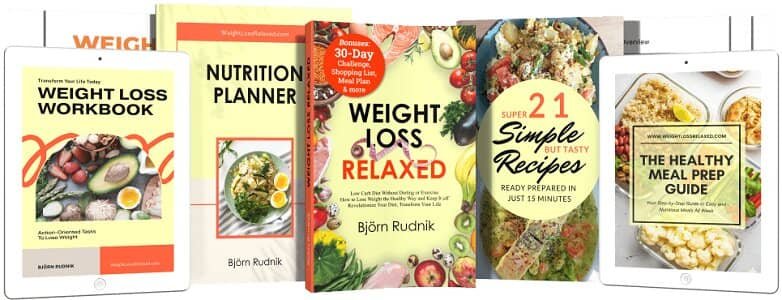
Another major attraction is the collection of eight bonuses listed with the program.
Bonus #1: 14-Day Shopping List
The shopping list is designed to simplify grocery shopping during the initial two weeks.
Rather than standing in the supermarket wondering what to buy, you have a framework for selecting ingredients that fit the program.
For beginners, this can remove a surprising amount of friction.
Bonus #2: Simple But Tasty Recipes
This bonus includes 21 simple recipe ideas designed to be prepared quickly.
The emphasis is on convenience, making it easier for users to put the program’s principles into practice without spending a great deal of time cooking.
Bonus #3: Meal Prep Guide
Meal preparation can make healthy eating easier, especially for busy households.
The meal prep guide is intended to help users prepare food more efficiently so healthier options are available when hunger strikes.
That can reduce the temptation to rely on convenient but less nutritious alternatives.
Bonus #4: Community Access
Community support can provide additional accountability.
Members can share progress, challenges and encouragement with people working toward similar goals.
For people who struggle with motivation when dieting alone, this could be one of the more useful additions.
Bonus #5: Weight Loss Workbook
The workbook provides action guides, exercises and checklists intended to help users implement the lessons.
Rather than simply consuming information, users are encouraged to turn the information into concrete actions.
Bonus #6: Fat Burning Turbo
This bonus provides a list of foods promoted as supportive choices during the weight loss process.
It is positioned as an additional resource for making better food decisions.
As with any nutrition claim, no single food should be viewed as a magic fat burner. Sustainable weight management depends on the overall dietary pattern and lifestyle.
Bonus #7: Nutrition Planner
The nutrition planner is designed to monitor areas such as hunger, energy, satisfaction and weight trends.
This could be useful for people who want awareness without becoming overly focused on precise calorie numbers.
Bonus #8: Tools & Templates
The final bonus includes practical templates such as action overviews, checklists, conversation templates and a personal commitment document.
For someone who likes structure, these materials may make the program easier to follow.
Who Is Weight Loss Relaxed Best Suited For?
Based on the official product information, Weight Loss Relaxed appears particularly suitable for adults who:
- Have tried several diets without maintaining results
- Dislike counting calories
- Do not want to weigh every food portion
- Prefer simple meals
- Have limited time for cooking
- Want an uncomplicated weight loss plan
- Need more structure and accountability
- Want to focus on healthier everyday food choices
The program is specifically marketed toward men and women primarily between 30 and 60, although the underlying principles may appeal to a broader audience.
It may be particularly interesting for people searching for weight loss over 40, weight loss over 50 or a straightforward weight loss plan for beginners.
Do You Need Exercise With Weight Loss Relaxed?
According to the official product page, exercise is not required to begin the program.
The primary focus is dietary behavior rather than intense workouts.
That can make the program appealing to people who are currently inactive or who dislike traditional exercise-based weight loss programs.
However, the fact that exercise is not required by the program should not be interpreted as meaning physical activity has no health benefits. Regular movement can be an important component of overall health and weight management.
The key attraction here is simply that the program does not make hard workouts a prerequisite for getting started.
Can Weight Loss Relaxed Really Help You Lose Weight in 1–2 Weeks?
This is probably the first question potential buyers will ask.
The program is explicitly positioned as a 1–2 week weight loss kickstart and the official sales material suggests users may notice early changes when following the plan.
However, it is important to maintain realistic expectations.
People lose weight at different rates and short-term scale changes can include fluctuations in water weight as well as changes in body fat. Your results can depend on your starting point, food intake, activity level, adherence, sleep, stress and other individual factors.
Therefore, the strongest argument for Weight Loss Relaxed is not that it promises an identical result for everyone.
Instead, it provides a structured system intended to help you begin making consistent changes immediately.
Early progress can certainly be motivating, but sustainable weight management is better viewed as a longer-term process.
Is Weight Loss Relaxed a Crash Diet?
Based on the supplied product information, the program is explicitly positioned as not a crash diet.
It does not emphasize starvation, extremely small portions or highly restrictive food rules.
Instead, the system focuses on food choices, meal structure, practical planning and gradual habit development.
That is one of the more appealing aspects of the program.
A sustainable approach generally needs to be something you can live with rather than something you can tolerate for two weeks.
The Weight Loss Relaxed philosophy attempts to make healthier eating feel normal rather than punishing.
Pros and Cons of Weight Loss Relaxed
Pros
Simple approach: The program is designed to avoid complicated tracking.
No calorie counting: Attractive for people who dislike logging meals.
Easy meal structure: Plate rules make the method relatively straightforward to understand.
Real-world foods: The program focuses on ordinary supermarket ingredients.
Convenient bonuses: Shopping lists, recipes, meal prep resources, worksheets and templates add practical value.
Structured kickstart: The initial 1–2 week framework can help people stop planning and start acting.
Long-term focus: The final part addresses maintaining habits and managing setbacks.
Community support: Additional accountability may help people who struggle to stay motivated alone.
Cons
Results vary: There is no guarantee that every person will lose a particular amount of weight within 1–2 weeks.
Less numerical precision: People who prefer detailed calorie and macro tracking may want a more data-driven system.
Requires consistency: Even a relaxed method still requires users to follow the recommended habits.
Not a substitute for medical care: Anyone with medical conditions, nutritional concerns or special dietary requirements should seek appropriate professional advice.
Is Weight Loss Relaxed Worth Buying?
After looking at the structure of the program, its biggest advantage is clear: simplicity.
Weight Loss Relaxed is not trying to win people over with an impossibly complicated diet protocol. Instead, it presents a practical framework based around food swaps, plate guidelines, everyday meals, goal-setting, support and a clearly defined kickstart period.
For anyone who has repeatedly started strict diets only to abandon them because they became exhausting, that could be a meaningful advantage.
The included bonuses also strengthen the overall package. A shopping list tells you what to buy. Recipes give you practical meal ideas. The meal prep guide helps with organization. The workbook and planner encourage action. Community access can provide additional motivation.
In other words, the program is not just information.
It is designed as a system.
That distinction makes Weight Loss Relaxed especially interesting for someone who has already read countless weight loss articles but still has trouble translating information into everyday behavior.
Final Weight Loss Relaxed Review
The weight loss industry is full of complicated solutions.
Weight Loss Relaxed takes almost the opposite position.
Instead of making dieting feel like a second job, it attempts to simplify the process with practical rules that can be remembered and applied in real life.
The focus on weight loss without calorie counting, simple food swaps, visual plate guidelines, convenient meals and structured short-term goals makes the program approachable for beginners and experienced dieters alike.
Its eight-part core program adds another layer of value by addressing motivation, support, current eating habits, personalized planning, implementation and long-term maintenance.
The eight bonuses provide even more practical resources, particularly for someone who wants guidance rather than having to figure everything out independently.
The biggest reason to consider Weight Loss Relaxed Kickstart is therefore not a promise of instant transformation. It is the possibility of replacing an exhausting, complicated dieting mindset with a method that feels more manageable.
The official product page highlights the creator’s claim of losing 66 pounds using this approach, but every individual’s experience will be different. The 1–2 week timeframe should also be regarded as a kickstart objective rather than a guaranteed outcome.
For readers who are tired of counting every calorie, weighing every meal, following complicated recipes and repeatedly starting over, Weight Loss Relaxed offers a refreshingly simple alternative.
You get a clear starting point, practical resources, a structured action plan and tools designed to help you continue beyond the first two weeks.
Overall, Weight Loss Relaxed is a compelling option for anyone looking for a simple, practical and less obsessive approach to improving their eating habits and working toward sustainable weight loss.
The real appeal is that it aims to make healthy choices easier to repeat.
And when it comes to long-term weight management, consistency is often far more useful than constantly searching for the next extreme diet.